
Summer HVAC Survival Guide for Jacksonville Homes
Summer HVAC Survival Guide for Jacksonville Homes
Summer in Jacksonville is not for the faint of heart. Three or four months of 90-plus degree days, thick humidity, afternoon thunderstorms, and long stretches where the AC never quite gets a break. For your HVAC system, it is the toughest time of year. For your family, it is the season when reliable cooling matters most. The homeowners who cruise through summer without major HVAC drama are not lucky. They just prepared better and paid attention along the way. This survival guide covers everything you need to know to make it through a Jacksonville summer in comfort.
Comfort Zone of North Florida has helped families across Jacksonville, Mandarin, Orange Park, and the beaches survive summer after summer. Here is what actually works.
Start With a Professional Pre-Summer Tune-Up
Spring is the best time to schedule HVAC service in Jacksonville. Before demand peaks and service schedules fill up, a professional tune-up gives you a chance to catch small problems, clean the coils, verify refrigerant levels, test electrical components, and confirm the system is ready for the marathon ahead.
Skipping this step is the single most common reason for mid-summer breakdowns. A tune-up costs less than a single emergency repair call, and it dramatically reduces the chance you will need one.
Change the Filter Every Month
During Jacksonville summer, your AC may run 18 to 20 hours a day. That kind of runtime clogs filters fast. A dirty filter restricts airflow, forces the blower to work harder, and increases the chance of a frozen coil. Set a phone reminder to change the filter every 30 days from May through October. Buy filters in bulk so you always have one ready.
Our guide on when to replace your HVAC filter explains the details for different filter types.
Set the Thermostat Realistically
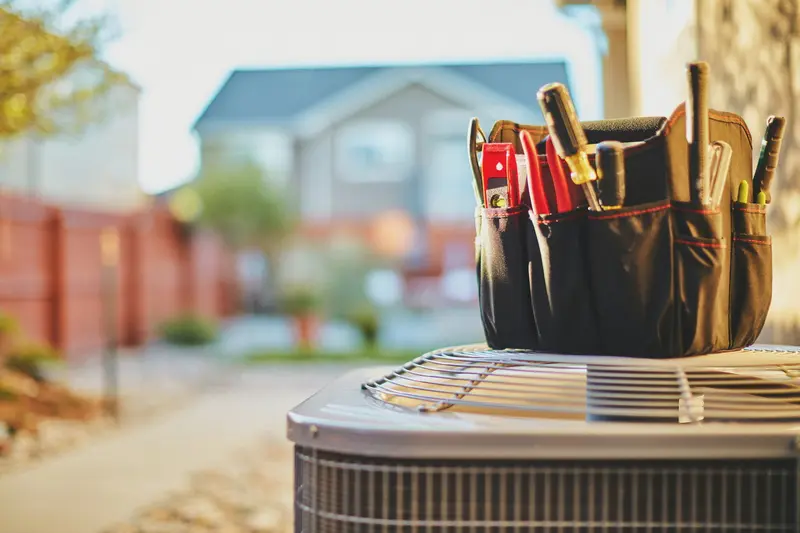
Air conditioner with maintenance tools in residential back yard
When it is 96 degrees outside, your AC cannot make the house 68 degrees no matter how low you set the thermostat. Setting unrealistic targets only forces the system to run nonstop without ever satisfying the call, which stresses every component. A reasonable Florida summer setting is 76 to 78 degrees when home and a few degrees higher when away.
For every degree you raise the thermostat, you save roughly three percent on cooling costs. Combined with ceiling fans, most families find 78 degrees perfectly comfortable.
Keep the Outdoor Unit Clean and Clear
Walk around your outdoor condenser at least once a month during summer. Clear at least two feet of space on all sides, trim back any bushes or overhanging branches, pull weeds, and rinse the coil gently with a garden hose to remove pollen, dust, and grass clippings. Skip the pressure washer, which can bend the delicate fins.
A blocked or dirty outdoor unit cannot release heat efficiently, which forces the entire system to work harder.
Close Blinds and Curtains During the Hottest Hours
Direct sunlight through windows dramatically increases the cooling load on your AC. Close blinds, drapes, or shades from late morning through early evening, especially on west and south-facing windows. This simple habit can drop indoor temperatures by several degrees and take real strain off the system.
For long-term savings, cellular shades and solar window film both block significant heat while still letting in some natural light.
Use Ceiling Fans Strategically
Ceiling fans do not cool the air, but they make you feel several degrees cooler by moving air across your skin. In occupied rooms, fans let you raise the thermostat without losing comfort. Just remember to turn them off when you leave the room. Set fans to spin counterclockwise in summer to push cool air downward.
Reduce Heat and Humidity From Household Activities
Cooking, running the dryer, and running the dishwasher all add heat and humidity inside the house. During the hottest part of summer, save these activities for early morning or evening when your AC is not already working at capacity. Grilling outside, using a slow cooker, or air-drying laundry can all help ease the burden. Long hot showers also add humidity, so ventilation fans should run during and after every shower.
Watch for Warning Signs
Catching a small issue in June is much cheaper than dealing with a full system failure in August. Pay attention to weak airflow from vents, warm air coming out instead of cool, ice forming on the indoor unit or refrigerant lines, longer than normal cooling cycles, water pooling around the air handler, unusual noises, and burning or musty smells.
Any of these deserves a call, not a wait-and-see approach.
Manage Humidity Actively
Jacksonville summer humidity often sits above 80 percent, and if your AC cannot pull it down, your home will feel uncomfortable no matter what temperature the thermostat reads. Signs of a humidity problem include sticky indoor air, condensation on windows, musty odors, and mildew spots in bathrooms or closets. A whole-home dehumidifier is often the best solution when the AC alone cannot keep up. Our blog on Florida humidity and HVAC performance covers this in more depth.
Protect Against Storm Damage
Jacksonville summer thunderstorms bring lightning and power surges that can fry HVAC electronics in an instant. A whole-home or dedicated HVAC surge protector is one of the smartest investments a Florida homeowner can make. The cost is minor compared to a fried compressor or control board.
After any major storm, take a moment to verify your system is running normally.
Prepare for the Worst-Case Scenario
Even with perfect preparation, breakdowns can happen. Identify a trusted local HVAC company now, save their number in your phone, and consider enrolling in a service agreement so you have priority when things go wrong. Have a plan for extreme heat if the AC goes down, including a way to reach a cool location if the repair takes more than a few hours.
Enjoy the Summer
Jacksonville summers are demanding, but they do not have to be miserable. With a well-tuned system, smart daily habits, and attention to warning signs, your HVAC will keep you comfortable through the worst of the heat. If you need service, a tune-up, or a full system evaluation, Comfort Zone of North Florida is ready to help. Call us at (904) 406-0070 to schedule an appointment.

Tags: